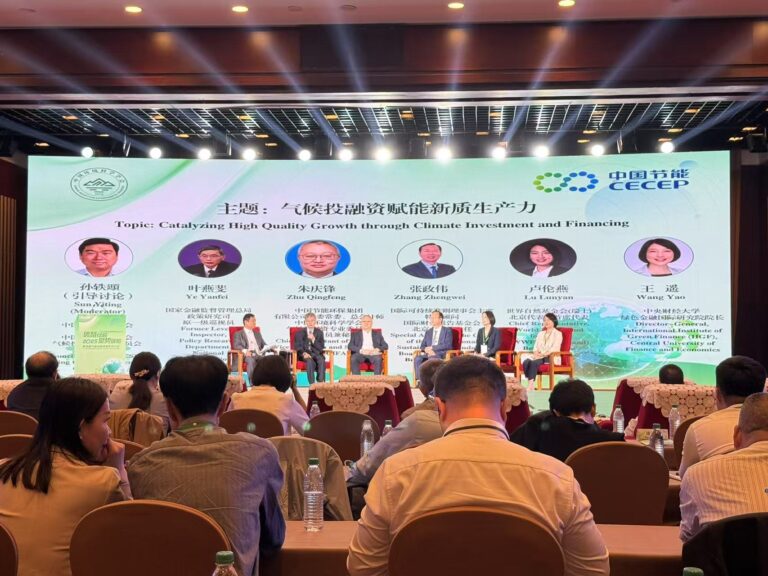
On 22 May 22, the 4th International Climate Investment and Financing Conference took place in Beijing. The event was co-hosted by the Chinese Society for Environmental Sciences, China Energy Conservation and Environmental Protection Group (CECEP), and Sina Finance.
Under the theme “Carbon-Green Synergy, Breaking Bottlenecks: Empowering New Quality Productive Forces through Climate Investment and Financing”, the conference featured a plenary session and six parallel forums. Discussions focused on pilot experiences and future directions in climate finance, financial strategies toward COP30 and global climate goals, targeted support for green and low-carbon development, the role and challenges of carbon markets in the low-carbon transition, sustainable disclosure for green transformation, and the contribution of technological innovation and finance to high-quality development.
The event offered a comprehensive look at how climate investment and financing can accelerate sustainable development, presenting innovative strategies and systemic approaches for fostering new quality productive forces.
Dr. Ahmatjan Rouzi from DCZ participated in the plenary and in Forum 2, “Towards COP30: Financing the Acceleration of Global Climate Action.”
Opening speeches
At the opening of the forum, Mr. LI Gao, Vice Minister of Ecology and Environment of China, delivered remarks highlighting China’s achievements in climate mitigation and expressing the country’s strong commitment to international cooperation.
Mr. ZHAO Hualin, former Chairman of the State-owned Assets Supervision and Administration Commission (SASAC) under the State Council, reflected on recent climate-related disasters and stressed the importance of adhering to the goals of the Paris Agreement. He emphasized that a green, low-carbon economic transition is essential for promoting high-quality development, and called for the establishment of a clear climate finance mechanism to support effective mitigation and achieve China’s dual carbon goals.
Mr. DING Zhangchun, Deputy Party Secretary of Beijing, reported that the city has achieved a 60% reduction in PM2.5 levels. He also introduced the Beijing Green Economy Fund as a dedicated investment vehicle for climate-related projects.
Mr. WANG Xin, Director General of the Research Bureau at the People’s Bank of China, noted the Bank’s efforts in developing indicators for climate finance and biodiversity protection. He shared that RMB 1.3 trillion in green loans were issued in 2024, citing examples from Hebei and Zhejiang provinces.
Mr. Marcelo Mena-Carrasco, former Minister of Environment of Chile and President of the Global Methane Hub, underscored the importance of reducing methane emissions. He highlighted several successful initiatives, including the “Too Good to Waste Initiative,” the “Climate Bonds Initiative,” and the World Bank’s CH4D program.
Mr. Safdar Parvez from the Asian Development Bank (ADB) Beijing office remarked that technologies such as artificial intelligence and blockchain could enhance the efficiency and transparency of climate finance.
Forum 2: Towards COP30 – Financing the Acceleration of Global Climate Action
This sub-forum focused on innovative financial solutions and strategic objectives in the lead-up to COP30 in Brazil. It was co-organized by GIZ, the World Resources Institute (WRI), and the Climate Investment and Finance Committee of the Chinese Society for Environmental Sciences.
Mr. Martin Hansen, GIZ East Asia Director, shared Germany’s past contributions and ongoing commitment to climate finance.
Mr. Hum Kim from the Asian Infrastructure Investment Bank proposed “Beyond the Horizon: Innovative Financing for Accelerated Global Climate Action Towards 2030.”
Ms. XIAO Baoling discussed the role of diversified investment and financing mechanisms in advancing the industrial development of carbon capture, utilization, and storage (CCUS).
Mr. Kamran Khan, Managing Director of Sustainable Finance for Asia-Pacific at Deutsche Bank, elaborated on the bank’s ESG strategies and emphasized the importance of trade, cooperation, and knowledge-sharing.
Mr. TANG Dingding of WRI introduced initiatives under the Regional Comprehensive Economic Partnership (RCEP), particularly focusing on green trade and South-South cooperation.
Mr. Luiz Keppe presented Brazil’s agenda for COP30 and introduced the “Tropical Forest Forever Facility” (TFFF), aimed at preserving and protecting tropical rainforests.