


On 15–16 September 2026, the Sino-German Whole-Plant Corn Silage Value Chain Innovation Field Day took place in Hohhot, Inner Mongolia. The event brought together experts, representatives of dairy farms, agricultural service providers, research institutions, advisory organizations, and technology companies from China and Germany.
The Sino-German Agriculture Centre (DCZ) and the Institute of Animal Science (IAS) of the Chinese Academy of Agricultural Sciences (CAAS) organized the event with support from the Inner Mongolia Dairy Association. The two-day program combined a technical forum, a company exhibition, live machinery demonstrations in Horinger County, and a visit to the Innovation Incubation Center operated by Muxin Technology Development. Participants examined the entire value chain—from crop production and harvesting to ensiling, quality assessment, and feeding.
The event was implemented under the German program Internationale Netzwerke Agrar- und Ernährungswirtschaft (INA). The project aims to establish a Sino-German innovation network for efficient and sustainable feed production in China’s dairy sector. In cooperation with China’s High-Quality Silage Initiative (GEAF), it connects German agricultural technology companies with Chinese demonstration farms, dairy enterprises, extension services, and technical institutions affiliated with the Ministry of Agriculture and Rural Affairs (MARA).
China’s dairy sector has expanded rapidly, increasing demand for standardized production and feeding systems. The availability of high-quality, locally produced forage, however, remains a challenge. The INA project therefore focuses on improving forage quality and standardization, reducing losses and costs, supporting efficient feeding, and advancing digital quality management and traceability. These measures can also contribute to animal health and welfare and reduce environmental impacts across feed production, processing, and logistics.
Forum connects silage quality with dairy performance
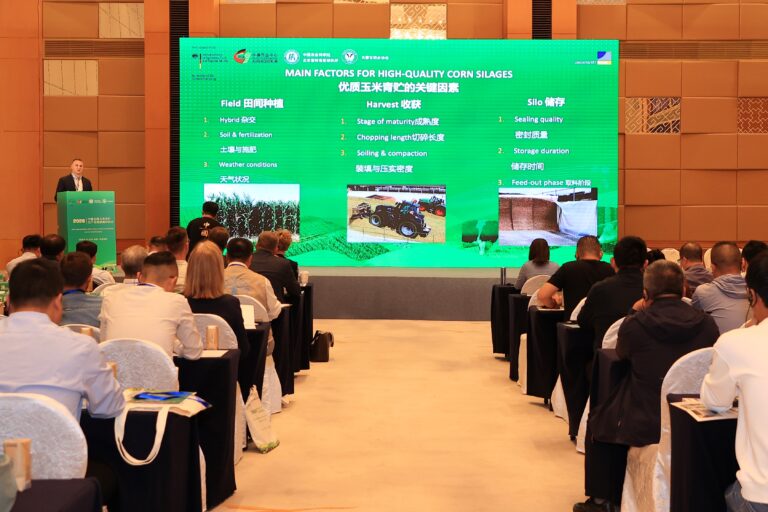
The technical forum examined how decisions at each stage of the production chain influence silage quality. Experts addressed crop production, harvesting technology, fermentation, quality assessment, digital management, and dairy cow feeding.
Dr. ZHAO Meng of Modern Dairy described corn silage as an important source of forage and energy in dairy rations. Its quality affects feed intake, milk production, feed efficiency, and costs. His contribution highlighted the importance of field assessment, variety selection, maturity monitoring, kernel processing, rapid silo filling, compaction, and airtight sealing.
Prof. Thomas Hartinger of the University of Bonn emphasized that farms must manage silage quality from the field through the feed-out phase. Alongside nutritional value, he highlighted feed hygiene, aerobic stability, physically effective fiber, and mycotoxin risks. He also discussed emerging approaches such as mixed ensiling, intercropping, and the use of sensors in crop production, harvesting, and feeding.
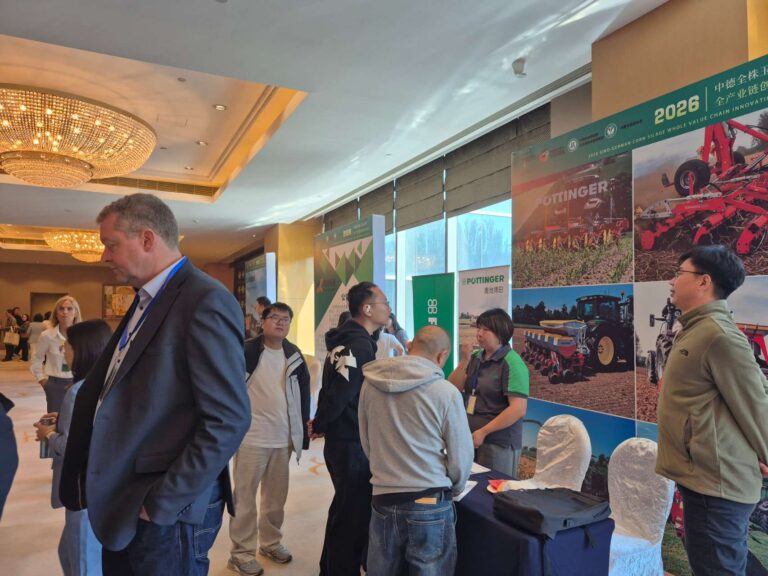
Further presentations showed that the quality potential of silage corn develops well before harvest. FENG Cissy of PÖTTINGER addressed seedbed preparation, precise sowing, and mechanical crop management. BASF and Bayer CropScience presented approaches to crop health, nutrient management, and crop protection. ZHANG Shuang of Liaoning Wanying Agricultural Technology discussed the potential of corn with a higher protein content to reduce the need for purchased protein-rich feed.
Coordinated management protects feed value
Several speakers identified harvest timing as one of the most important management decisions. Depending on crop conditions and the production system, they placed the target dry matter content at approximately 30–37%. Harvesting too late may increase starch content but can reduce digestibility and make compaction more difficult.
Harvesting technology determines chop length, particle structure, and kernel processing. ZHANG Jianpeng of CLAAS and JIANG Chengxi of KRONE presented technical approaches to processing the whole corn plant and breaking the kernels. Both emphasized that farms should assess harvest quality directly in the field by examining particle distribution, processed kernels, and the uniformity of the chopped material.
Contributions from ADDCON, SCHAUMANN, and SANO focused on compaction, fermentation, and aerobic stability. When oxygen enters the silage, yeasts can metabolize residual sugars and starch, generating heat and reducing feed value. Continuous compaction, rapid sealing, and careful management of the exposed silo face are therefore essential.
Silage additives can support fermentation and aerobic stability, but they must be selected and applied according to the crop material and storage conditions. They cannot compensate for inadequate harvesting, compaction, or sealing. Regular temperature measurements and thermal imaging can help farms detect heating before visible spoilage occurs.
Data links production with feeding
Digital quality management formed another focus of the forum. Frederik Vielhauer of IAK Agrar Consulting explained how farms can connect information from crop production, machinery, contractors, silos, laboratories, and dairy production. Combining this data can help identify where quality losses occur and support better management decisions.
Dr. ZHAO Liansheng of CAAS-IAS presented China’s Corn Silage Quality Score (CSQS), which combines nutritional and fermentation indicators to classify whole-plant corn silage. The China Whole-Plant Corn Silage Quality and Safety Report 2025 evaluated 1,217 samples from 21 provincial-level regions. The national average was 67.1 CSQS points, and 62.5% of the samples reached the two highest quality classes. The results also showed differences between regions, animal categories, and farm sizes, underlining the need for consistent sampling and transparent quality benchmarks.
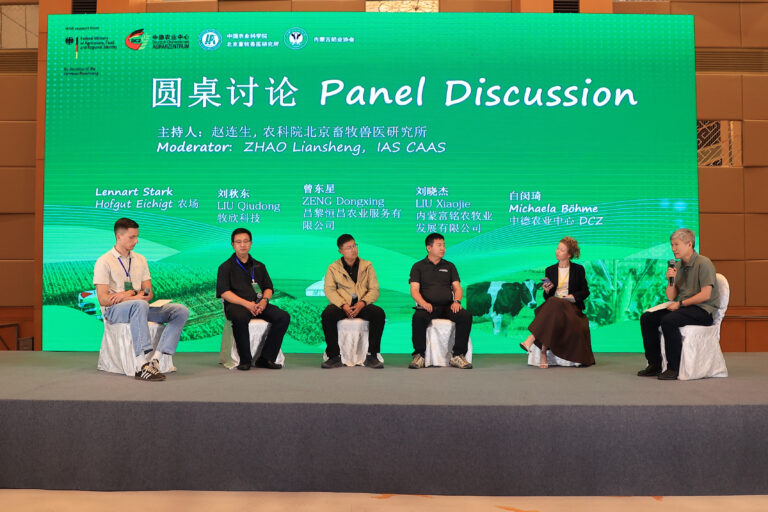
The forum also examined how silage quality translates into dairy performance. Lennart Stark presented feed management practices at Hofgut Eichigt, Germany’s largest organic dairy farm, which keeps 1,400 dairy cows. The farm regularly monitors dry matter, ration structure, and mixing quality and follows defined procedures for loading and mixing its total mixed ration.
Dr. LI Shucong presented practical recommendations for Chinese dairy farms, including dry matter control, rapid silo filling, intensive compaction, and airtight sealing. Together, the contributions showed how forage analyses, feed intake, milk yield, and animal health data can help farms adjust their rations and improve feeding efficiency.
Field demonstrations connect knowledge with practice
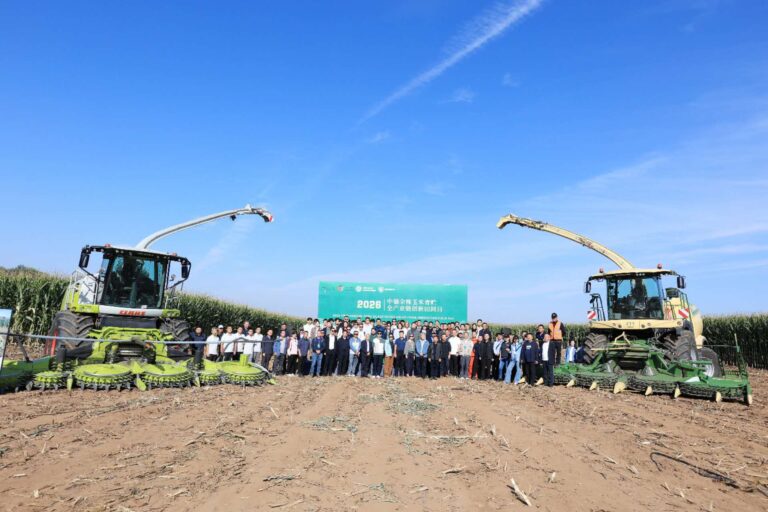
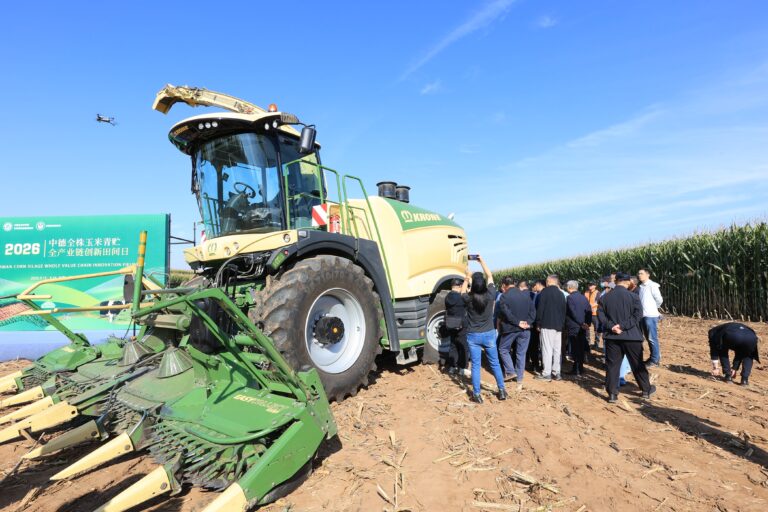
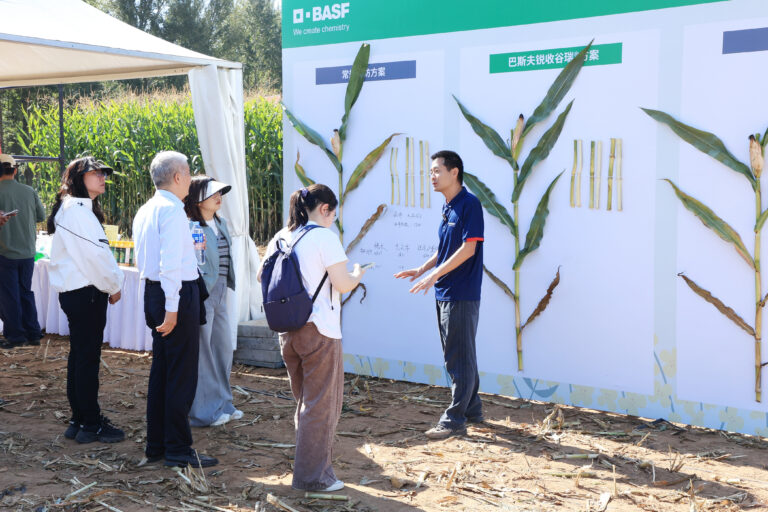
On 16 September, participants visited a field demonstration site in Horinger County. The demonstration site produces silage for Helin No. 1 Farm—a farm under the management of Chinese dairy producer Modern Dairy. Companies presented solutions for crop health and protection, sowing and crop management, harvesting, ensiling, and quality management. The exhibition included machinery and technical solutions from CLAAS, KRONE, and PÖTTINGER as well as inputs and management approaches from BASF, Bayer CropScience, and ADDCON.
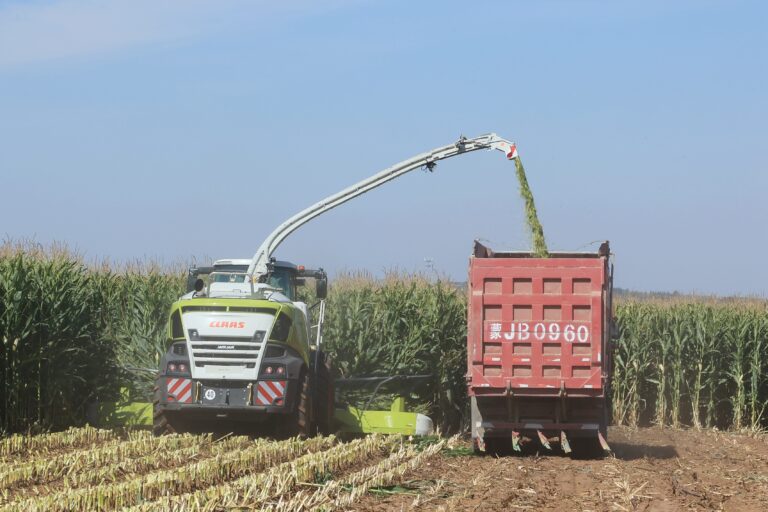
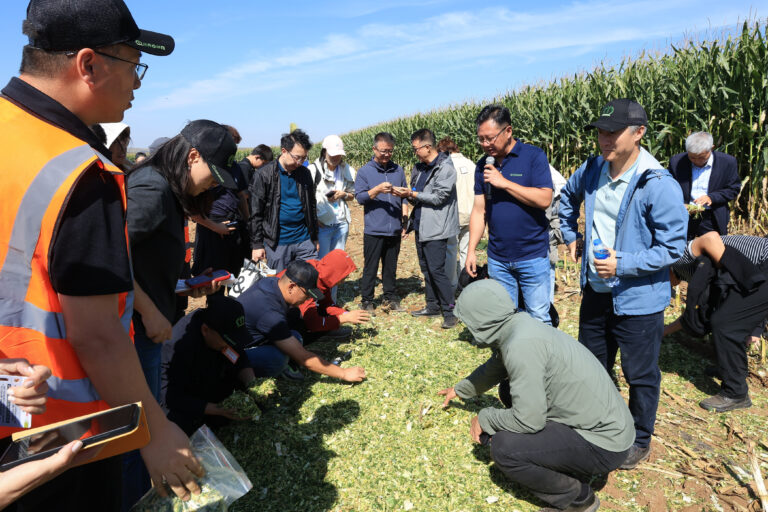
During the live demonstrations, CLAAS and KRONE presented forage harvesters working under field conditions. Participants examined chop quality and kernel processing and discussed machinery settings with company representatives. The demonstrations showed how machinery performance, operator skills, and quality control interact to reduce harvest losses and create favorable conditions for ensiling.
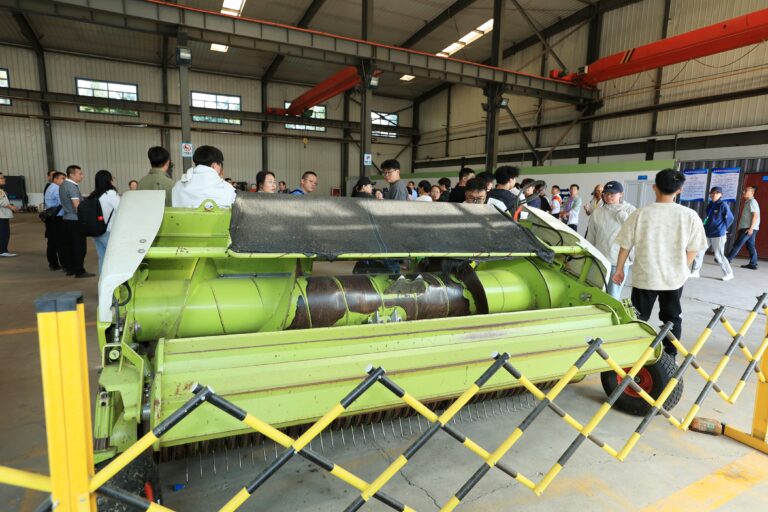
In the afternoon, participants visited the Innovation Incubation Center operated by Muxin Technology Developmen. The center presented its work on forage quality standardization, digital platforms, agricultural machinery operator training, and smart energy systems for dairy farms. The delegation also visited its machinery maintenance and repair workshop. Discussions focused on operator training and the development of certification approaches. These activities aim to reduce quality problems caused by unsuitable machinery, incorrect settings, or inadequate operation and to strengthen professional services along the forage value chain.
By linking crop management, harvesting, ensiling, quality assessment, and feeding, the event demonstrated that consistent silage quality depends on coordinated decisions across the entire value chain. The exchange also created a basis for continued Sino-German cooperation on high-quality forage production, digital quality management, efficient feeding, and more sustainable dairy farming within the INA innovation network.
