On 15 and 16 January 2026, Sino-German Agricultural Centre (DCZ) experts participated in the Global Food and Agriculture Forum (GFFA), which brought together more than 60 ministers of agriculture from around the world, high-level representatives from international organizations, industry leaders, scientists, and civil society. The event was organized by the German Federal Ministry of Food, Agriculture and Regional Identity (BMLEH) this year under the theme: “Water. Harvests. Our Future.”
Martina Englhardt-Kopf, Parliamentary State Secretary, and H.E. Retno L. P. Marsudi, UN Secretary-General’s Special Envoy on Water and former Minister of Foreign Affairs of the Republic of Indonesia, opened the GFFA public program, emphasizing the interlinkages between water and food security.
The Cooperation Market in the foyer, gathering 27 exhibitors such as the Food and Agriculture Organization of the United Nations (FAO), GFA Consulting Group GmbH and IAK Agrar Consulting GmbH, offered extensive opportunities for exchange, networking, and partnership-building around innovative approaches to water, agriculture, and resilient food systems. The network meetings reflected a shift in development cooperation strategies by the BMLEH and the Federal Ministry for Economic Cooperation and Development (BMZ) toward more economically driven approaches and export promotion.
Sino-German panel discusses joint water challenges in agriculture
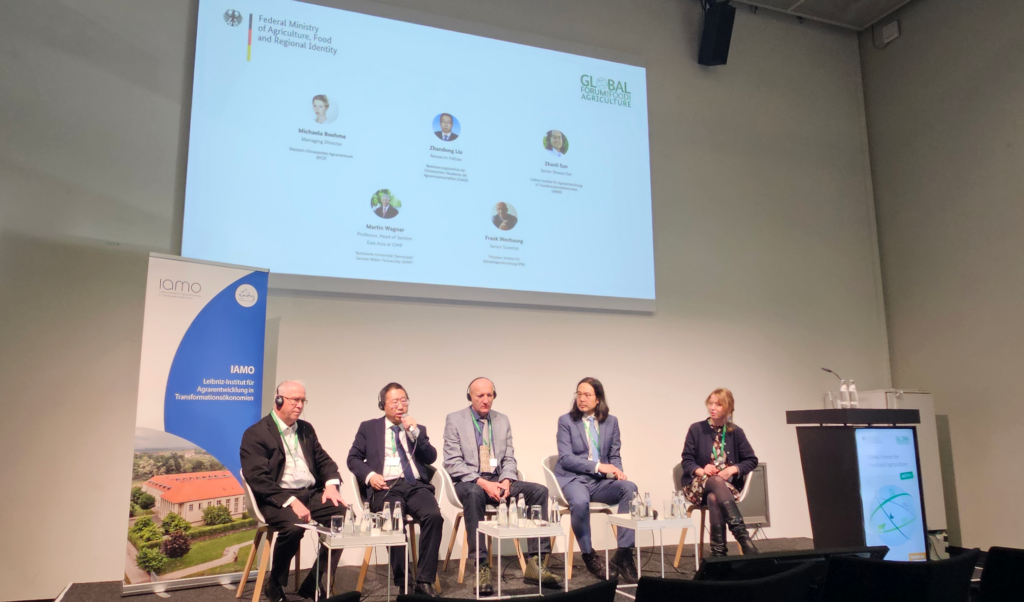
On Friday, 16 January, the DCZ hosted a panel on “Water, Food & Climate: Lessons from Sino-German Cooperation”. DCZ’s Managing Director, Dr. Michaela Böhme, moderated the panel, noting that China has experimented with a wide range of water management approaches, and that both China and Germany have valuable experiences that could form the basis for mutual exchange. The four panelists, Dr. SUN Zhanli, Leibniz Institute of Agricultural Development in Transition Economies (IAMO), Dr. Frank Wechsung, Potsdam Institute for Climate Impact Research (PIK), Dr. LIU Zhandong, Chinese Academy of Agricultural Sciences (CAAS), and Prof. Dr.-Ing. habil. Martin Wagner, Technische Universität Darmstadt / German Water Partnership, provided insights into scenarios for water availability in China and Germany under climate change and the strategies and technologies to use water more efficiently in agriculture under constraints.
China’s agricultural sector heavily relies on irrigation technologies, with massive infrastructure projects such as the South-to-North Water Transfer transferring water over thousands of kilometers. While the large-scale water diversion supports farmers in the heavily farmed and industrialized northern regions, the long-term sustainability remains uncertain. Dr. Liu illustrated the challenges in the northwestern region of China where grain and cotton production dominate. Agricultural water use exceeds the replenishment of groundwater aquifers, and, combined with the reduction of ecological measures such as the preservation of riparian vegetation and windbreaks, it exacerbates ecological conflicts. Water-saving technologies have been developed to address these issues, including drip irrigation, real-time soil moisture sensors, and precision-controlled valves. The subsequent discussion highlighted the role of innovative water management solutions and high-tech tools, but also pointed out that many farmers have limited access.
DCZ hosts Sino-German panel on water-related challenges in agriculture
As part of the science dialogue, the DCZ experts facilitated further exchanges between researchers from the CAAS and German research institutions such as the Johann Heinrich von Thünen Institute, Federal Research Institute for Rural Areas, Forests and Fisheries (Thünen Institute), the Leibniz Institute for Agricultural Engineering and Bioeconomy (ATB), and IAMO.
Supporting German agri-businesses in partner countries
A networking event on 16 January by GFA, General Agent of the Bilateral Cooperation Program (BKP) of BMLEH, provided an opportunity for BKP projects to exchange experiences in their respective partner countries and discuss new instruments and approaches designed to support Germany’s new agricultural export strategy. Dr. Michaela Boehme joined the GFA networking event as a speaker, sharing her experiences from DCZ’s work with business stakeholders in China. She called attention to the need for German agri-food businesses to early track changes in merchandise and technical developments in Chinese markets, aligning their products with country-specific requirements.
She also emphasized the ’Big Country Effect,’ illustrating that even a tiny niche market in China will reach a proportionally large consumer base compared to European markets, and that Chinese consumer habits are currently changing rapidly, enabling investors to address these new target groups.