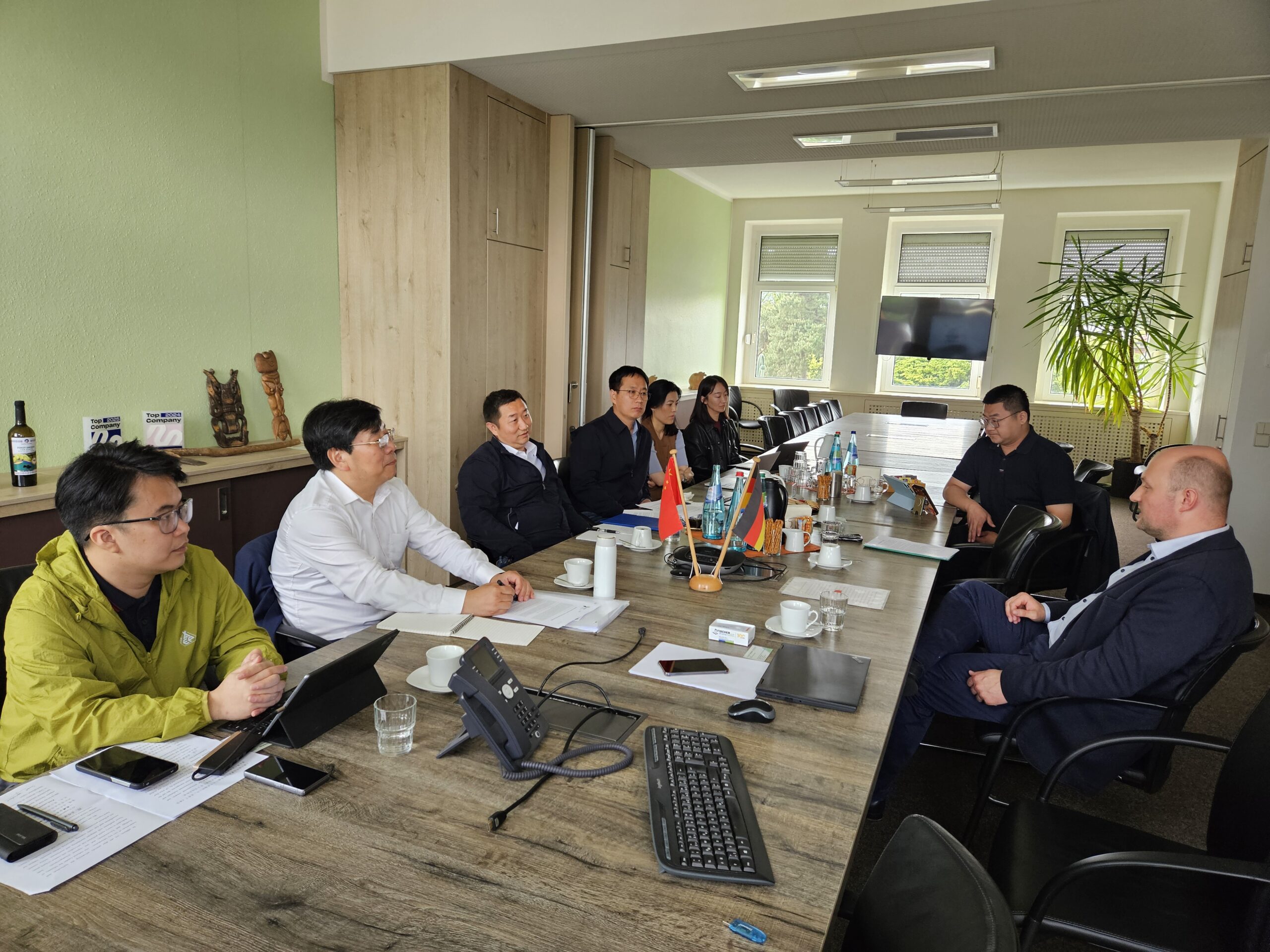
On 20 May 2026, IAK Agrar Consulting GmbH welcomed a high-level delegation from the Technical Centre for Soil, Agriculture and Rural Ecology and Environment (TCARE) and the Guangxi Research Academy of Environmental Sciences (GRAES) for an intensive technical dialogue in Leipzig. The meeting focused on current developments in European and Chinese soil management, with particular attention to soil monitoring, contaminated site remediation, soil health, and emerging pollutants.
The event took place at the premises of IAK Agrar Consulting GmbH and was opened by Stanimira Penkova Kranich. In her welcoming remarks, she introduced the work of IAK and DCZ, highlighting the importance of international cooperation for the development of sustainable environmental protection and soil management strategies.
A key part of the program was a technical presentation by Christian Wiese. Under the title “Overview on Management of Soils in Germany in Context of the Legal Situation in the EU,” he presented the current legal and institutional framework for soil management in Germany and the European Union.
One major focus was the new European Soil Monitoring Law, which aims to establish, for the first time, a harmonized framework for monitoring soil health across the EU. The presentation covered the objectives of the EU Soil Strategy for 2030, planned monitoring and reporting systems, and implementation challenges for EU member states. Wiese also explained Germany’s federal responsibilities, existing soil monitoring programs, and the role of research institutions and environmental authorities in soil protection.
The Chinese delegation showed strong interest in Germany’s experience with contaminated sites and polluted agricultural soils. Discussions included practical examples of remediation measures at former military and industrial sites, management of pollutant inputs in river floodplains, and innovative approaches such as phytoremediation and sustainable recultivation of former mining areas. Emerging pollutants such as PFAS (“forever chemicals”) and their relevance for soil and water protection were also discussed.
In return, the Chinese partners presented recent developments in China’s soil policy framework. Since the 13th Five-Year Plan, China has implemented extensive measures to prevent and control soil pollution. These include national programs to reduce heavy metal contamination, remediation of polluted agricultural land, and the establishment of new systems for soil monitoring and soil health management. According to the delegation, the safe utilization rate of contaminated agricultural land in China has now remained stable at over 92%.
The exchange also addressed future challenges related to soil health, sustainable land use, and biodiversity. Both sides emphasized the growing importance of scientific cooperation, joint research initiatives, and international knowledge platforms to address global environmental challenges.
The delegation included representatives from TCARE and GRAES, including SUN Yangzhao, Director of GRAES, and CHEN Hexiao, Assistant to the Director of GRAES and Director of the Guangxi Environmental Protection International Cooperation and Exchange Office.
The meeting in Leipzig further strengthened the technical dialogue between German and Chinese institutions in the field of soil and environmental protection. It clearly demonstrated that sustainable soil management and the protection of healthy soils are among the key global challenges of the future.